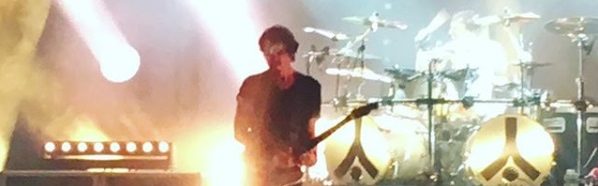
A somewhat recent news story was brought to my attention the other day, and in it, one of those old tropes about heavy music and violence reemerged. In November, a Colorado man murdered his wife and two young daughters (source). And then the media, in its hurry to find a reason for this, was quick to point out that after the man committed this heinous act, he looked up the lyrics to Metallica’s Battery:

Smashing through the boundaries
Lunacy has found me
Cannot stop the batteryPounding out aggression
Turns into obsession
Cannot kill the battery
Sure, it’s a powerful song with lyrics that evoke all kinds of things – power, violence, domination – but haven’t we already established that the link between metal and actual violence is nonexistent? Metal is misunderstood in this way (by the mainstream, at least). Metal fans are actually more likely to be the victims of a crime than the perpetrator. Even seen someone fall in the pit at a show? Immediately, we all help them back to their feet. The vast majority of metal fans are peaceful people who don’t want to hurt anyone, despite the lyrical content of the music. This case is an exception, not the rule. Heavy metal is an easy target – we don’t see the media attacking other kinds of music as much, do we?
There has been no research that supports the notion that music like this actually makes someone act violent or enables it. If anything, the research out there proposes that heavy and aggressive music actually helps people process their feelings. A team of researchers from Australia (source) found just that – that when the music matches one’s affective state, it actually helps them work through their feelings by listening and connecting to the music, rather than acting in less healthy ways (violence, substance abuse, etc.). So how might this work?
Like it or not, we’ve all got aggressive and destructive impulses. As much as humans can come together and create beautiful things, we also want to destroy things. Sometimes, we’re very aware of this – “I could just punch someone right now!” But other times, it’s much more subtle. We treat others badly, we treat ourselves badly, we get in our own way. Most people have a part of themselves that feels badly about something. Maybe your home life makes you feel powerless. Maybe your job makes you feel hopeless. Maybe, when you compare yourself to others, you focus on what you do not have. Don’t like the way you look? Feel insecure about your intelligence? Awkward in social situations? Everyone’s got something. If you don’t, you’re probably just trying to protect yourself from feeling vulnerable. Even narcissists are just wounded souls who don’t know what to do other than lash out.
So what do we do with these feelings? Well, something hopefully. Like noted above, sometimes the answer is to indulge in something unhealthy. For some, it’s drinking or drugs, compulsive overeating, self-criticism, self-injury, holding yourself back socially. There are lots of ways this can play out. But there are also some healthy outlets for these feelings, with creative pursuits being one of them. Good music is often music you can connect with. What if the aggressive nature of the instrumentals or the lyrics is something to connect with? Maybe we don’t feel as alone in our own suffering when someone else is singing about an experience we can relate to? The metal kid who goes home to an abusive household – maybe the music is his way to find others who feel the same way as he does. You’re anxious and depressed? Guess what – there are countless bands who have written songs about these same kinds of experiences. And when you’re feeling isolated in your “real life,” there’s a community of artists and fans who are putting themselves out there to connect with. And then maybe you’re not as alone anymore. (I’ll talk a bunch more about the community of metal and punk rock in another post).
And furthermore, when the music is aggressive in some way – distorted lower tones, played fast, content and imagery evoking all kinds of powerful things – it seems to have a physical element to listening. Even instinctively, we nod or bang our heads to the beat. We need to move, to get the energy out. Ever been to a show and felt exhausted afterwards? All this – the connection, the energy – is part of what actually helps metal fans process our negative feelings and impulses, instead of acting on them inappropriately. What happened in Colorado is awful. But it’s not the fault of Metallica or anyone else in the community. It’s an easy way for the media to reignite what I thought should be a settled issue about music and violence.
What do you all think? Sound off in the comments while you enjoy a destruction-themed Spotify playlist (here).

 Metal Health